Showing posts with label Things to make. Show all posts

Wednesday, October 5, 2011

How to Felt Wire....My Version.


I first got the idea for making headbands and hair ties for fund raising events during the felting camp at the Jondaryan Woolshed in Oct last year. Wendy Bailey had some very pretty hair ties with large felt flowers felted onto foam curlers. I had dismissed the idea as the ties appeared a little bulky for children's pony tails.


A few months later Abbie Vievers was visiting and over a cup of coffee I listened while she brain stormed ideas for an Open Day at the Serendipity Farm Animal Centre on October 22. I then remembered Wendy's pretty ties and thought they would be great for a felt demonstration and as a fund raiser. The bulkiness of the tie, and the time needed to make the flower, was a concern. I needed to simplify the process. Once again it was put on the back burner .....until I read an article in the 5th Issue of Felt Magazine by Anita Larkin "Felting around wire..Fungi Bracelet".  She used Corriedale wool which gave it a rustic look. I became excited when I found I had all the materials at hand .....recycled fly screen tubing from old screen doors, wire from repairing the fence and of course various types of wool.

I found Anita's process, while effective was awkward, and I needed to be simplify it if children were to felt wire on Open Day. I also needed to find a decoration that could be made quickly and still be as appealing as Wendy's flowers. I found the solution in Christine White's Uniquely Felt ..."Bodacious Bamboo" page 49.

So here is my version for felting around wire:

I decided that bracelets would be something quick and easy for the girls to make and snakes and lizards for the boys.  I wrapped the ridged fly screen tube (spline) around my wrist and let the ends overlap about an inch.  This should be a good length for the children's bracelets, hair ties and little snakes and lizards.
The tubing  can be found at hardware stores for about 60c metre or a little cheaper in packs of about 13 metres. I used galvanised wire from my tool box.  You can see the wire size in relation to the tube in the photo.


You will notice that the wire has a curve (a memory) which persists through out the process.  This can be used to advantage.  First the wire was bent back onto the topside of the curve to reduce the risk of scratching when worn.  The wire was stroked along the length when shaping to avoid kinks. However any shaping was avoided until finished.


Using a template: I used exactly the same process as I do when felting hats, bags etc.  I cut a piece of lino (floor vinyl) one and a half times the length of the tube and about inch wide, to use as a template. Fine Merino tops were laid across the template and a thin layer down the length.  It was then dampened down and felted with netting over the top till I was able to turn it over. 


The sides were folded in and tops were laid on the second side. At times I found very little wool was needed on the second side as the folded sides often cover the side quite well. I did need to do a full layer on the one in this photo though.  When it felted well and straining at the edges..... the ends were cut and the template pulled out. To pull template out the felt tube was pushed down like a sock part way and then grabbed at the bottom and pulled off. The tube is very fragile at this stage so go slow.


Covering the ends: Next some wool was hooked in the wire ends and pliers used to fix it firmly.  Here my method varies again from Anita's.  The wool is held between finger and thumb and the wire twirled so the wool winds around the tube and wire like a "cotton bud". This gives a good cover over the wire end.  When both ends were covered  the wire tube was pushed into in the felted tube. The ends of the felt tube were pulled over the first "cotton bud".  


To felt the tube: Wet the end thoroughly with soapy water and gently rub the felt ends together.  As it starts to felt together the end can be rolled on a wet towel or between the palms.  When the end has felted  onto the wool that was twirled around the wire ... push the felt tube up the wire and repeat the process on the second end.


Felt both ends well before felting the middle. To start the process roll the wire felt  between the palms as if washing you hands. Move the folds up and down as you felt to avoid them felting onto themselves.  The folds will shrink and disappear as you roll.


Last stages of rolling. Rolling on a wet towel helps in speed up the final process.  Putting it into hot water and then using a mallet as Anita suggests to shock the felt is also an option. 


The wire felt finished ready for decoration. I found this basic method quite quick and perfect for children on Open Day


Monday, September 20, 2010

Dream Catcher

My friends have thrown their hands up in despair once again.  They have children at home during the school holidays and need some projects for those rainy days that seem to be persisting at the moment.

This Dream Catcher was made about 18 months ago, when I was experimenting with some of Maggie Grey's  ideas .   I used a glue gun and a pipe cleaner. Then added bits and pieces like metallic threads, beads, bead wire, feathers, ribbons, cord and metallic paint. I also threw in some $2.0 glitter nail polish.


How to make a Dream Catcher

1. Thread some beads onto a pipe cleaner....space them out leaving room for wrapping metallic thread or other type of decorative thread.

2. Wrap the pipe cleaner in a pretty thread or cord.  You will find a link on Maggie Grey's blog (right)  called "Silly wrappings " which shows how to wrap pipe cleaners using the bobbin winder on the sewing machine.  However wrapping by hand can be fun too. 

3. Join the ends of the pipe cleaner to make a circle.

4. Join some bead wire or a short piece of a pipe cleaner to the bottom of the circle  and thread on some beads.  Leave enough at the end for attaching feathers or ribbons etc.

5. Attach the feathers or ribbon with some bead wire or wrap some thread firmly around them until secure.

6. Tie a cord or ribbon at the top of the Dream Catcher for hanging.

Now we are ready to create the pattern with glue.

You will need to practice on some baking paper first.

1. Use a piece of baking paper under your work

2. Allow the glue gun to heat for a few minutes until the glue starts to escape.

3. Have extra sticks of glue ready to back up the one you are using...always have the gun full so the flow is not interrupted.

4. Now try drawing circles, lines, and random shapes.  All these can painted or waxed later to embellish other projects (see below)

5. To create the web design on the Dream Catcher ..start at the edge of the pipe cleaner and wander randomly across until you reach the other side.  Repeat the process until you are happy with your shapes.

6. It is now ready to be painted with acrylics, waxed, or varnished with glittery nail polish.

Other decorations can be made in a similar way.
Take care not to put your decorations in hot water as the glue will disolve and cover everything it touches with a nasty sticky coat.

Glue Gun Patterns

Ready to be painted

Glue shapes painted with metallic acrylics and gold and silver wax

Gold waxed glue embellishment on free form bowl

Saturday, September 11, 2010

Down at the Woolshed - Helping Hands


Six little hands and two large hands rubbed and rubbed to create this blue nuno felted scarf.  I was hoping to receive a  photo showing the little Glennie Students' hands working hard on this creation at the Jondaryan Festival......... perhaps the photographer did not have a cropping tool on their computer that would hide the small faces appropriately.

The scarf was laid out in swirls for a change to see what effect it would have when it was felted.  The wool needed a little encouragement with a needle felting tooljust to get it started as the nylon weave was tighter than I had thought.


During the slow very wet days some of the volunteer children made this little basket of felted squares and felted soaps. The squares will be added to over time to create a childrens rug or mat, and the felted soaps will be passed on to my friend Yvette O'Brien in Toowoomba who ...with her group ...fill little bags they have made with toothbrushes, soap, shampoo etc. for the homeless and disadvantaged.


The squares were made using a resist to help keep the squares roughly the same size.  Two layers of coarse merino - 29 microns, were laid on each side.  Scraps of felt were cut into patterns and laid on the tops before wetting down.  Some of the scraps were already embellished and added to the effect.  A little glitz was sprinkled on the leaves in the square below.


When the resist started to buckle it was cut out and the two sides of the square were felted together to from a firm mat.


A gourd was also made during the Festival using the same coarse natural merino and a resist.  The cord was attached after the two layers on each side were wetted down and partially felted. The a third layer was added to each side and felted till the resist buckled and needed to be cut out.  It was then rolled, worked in hot water and thrown to shock the felt into shrinking further.

It was later dyed with food colouring...the kind one uses for cake icing.  Dyeing is a  new area for me.. so I experimented with a dye bath of water vinegar and a cap of green colouring.  Placed in an icecreanm container and microwaved for 6 minutes ...and then another 6 minutes after it had cooled a little.   The gourd was left hanging outside for some days. It did lose some of it's colour during the rain, but not much.

Many thanks to all the visitors and volunteers who helped make these felted pieces and the babies booties ...that I haven't shown here.  I hope they inspire to you to give felting ago.

Sunday, July 4, 2010

More on Free Form Bowls

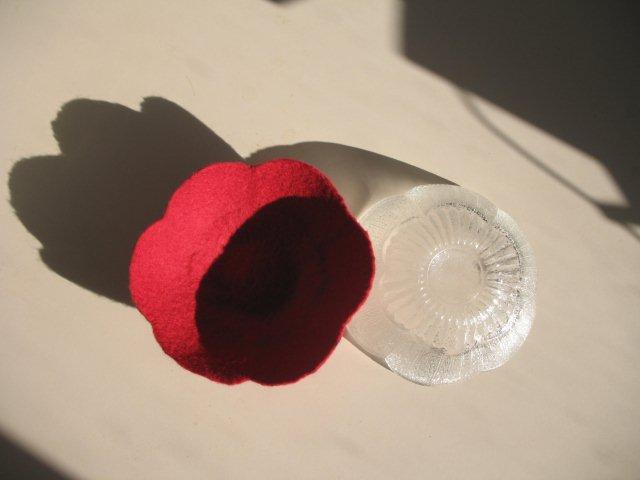
I am making a sculptured gourd to hang in the garden and wanted to try using Paverpol to turn it into an all weather sculpture.  First I need to test a small felt object to see how it would work.  So I decided to whip up another bowl for the  experiment.


I found a piece of felt left over from another project and a glass bowl for a mould.

I cut a rough square and placed it over the mould. 
It was then it worked hard with hot soapy water until it took the shape of the mould.

This time I decided not to curl the corners outwards. Instead I turned them inside and worked the felt into the scalloped edge.


When it began to firm I cut the surplus felt leaving a centimetre to allow further shrinkage and continued to work the bowl.

Next the scalloped edges were trimmed carefully...using the bowl as a guide.  The felt was removed and thrown into a bowl of hot water and vigorously worked.
The result was a crinkled piece of felt....this is fine and nothing to worry about . It shows that the felt is "fulling" nicely.


The felt was put back on the bowl and stretched and smoothed....paying attention to the scallops.  Then put into an old stocking and tied off tightly to hold the stretch while drying.

Hey Presto!  Here is the bowl ready for painting with Paverpol.


 As an after thought  I have decided reverse the pattern and have it on the inside.  So the bowl was wet down with hot water, stretched again over the bowl, and  popped into the old stocking to dry. 

I will upload the Paverpol results another time together with the sculptured gourd.  In the meantime I hope this gives you some more ideas to play with over the school hols.

Thanks for the great feed back so far .....and yes,  you can use the comment section without it being posted....no problem. I'll just treat it as a regular email. Keep warm,  Joan

Friday, July 2, 2010

Free Form Bowl

For days now I have been lost in the creative moment ....the "Zone".  It is usually the empty fridge that forces me to emerge, but this time I have been awakened by my dear friends Alice and Jo.  Cold weather during the current School holidays is keeping their grandchildren inside more than usual and they want something to keep them amused.

So here is one of my favourites...The Free Form Bowl from a Square of felt...

It can be made from all sorts of left over pieces or carefully fashioned ...which ever one prefers.

The first free form bowl I made (above) was fashioned from a square of felt  using hand washed and carded cross bred fleece.

Some had been dyed a wonderful gold colour with onion skins over a pit fire a few years before, some was "over" spun in chunks to form a 3D texture when felted ..the rest was left natural.  An interesting contrast in texture was created with some gold cord.  I preferred the coarser wool as it allowed me to create a nice sturdy bowl.


I don't remember the exact dimensions for this square...a little over 30cms (1 Foot square)..I think. 

To Begin: Find a bowl or vessel that you would like to use as your mould.  Cut  pieces of news paper and experiment with folding it around the vessel.  Then adjust the shape and size to suit. It doesn't have to be perfectly square..interesting vessels can be made from skewed shapes.

To make the felt  you will need to lay out a square 40% large than your paper pattern.  Lay the first layer wool in one direction, then the next layer at right angles to the first.  Continue to alternate the directions of the layers until you have enough to create a solid bowl.  The finer the wool the more layers needed.  I am assuming that the Granies and others who may like to try this already know the basics of fulling the felt using hot soapy water.

To be truly free form one can make the square first then find a mould to stretch it over later.  I used a pudding bowl...and tied an old stocking around the rim to hold the stretch.  I also worked the base of the bowl with my fingers.  If you don't like the shape ..simply take if off and find another mould to try.

After putting my felt square on the mould.... the wet corners were curled around  pencils and pens. They were then held in place with pegs while they dried. 

Variations would be to cut the corners and add extensions...or cut and curl 3 or 4 leaves into each corner.

You can twist it, curl it, tweak it, pull it, cut it , carve it and stretch it ...all limited only by ones imagination.

To finish: The bowl was stiffened with a mixture of 50/50 gel medium and water.  I only painted the inside of the bowl as I wanted the fluffy felt texture to remain on the outside.  Several coats of medium were used ...drying between each coat until I was happy with the degree of stiffness.


Free form Felting is a wonderful way to experiment with different effects and bring out the creative instinct in all of us.  Enjoy!